Establishing AI-Powered Dynamic Pricing at Scale: From Manual Updates to a Real-Time Intelligent Pricing Engine

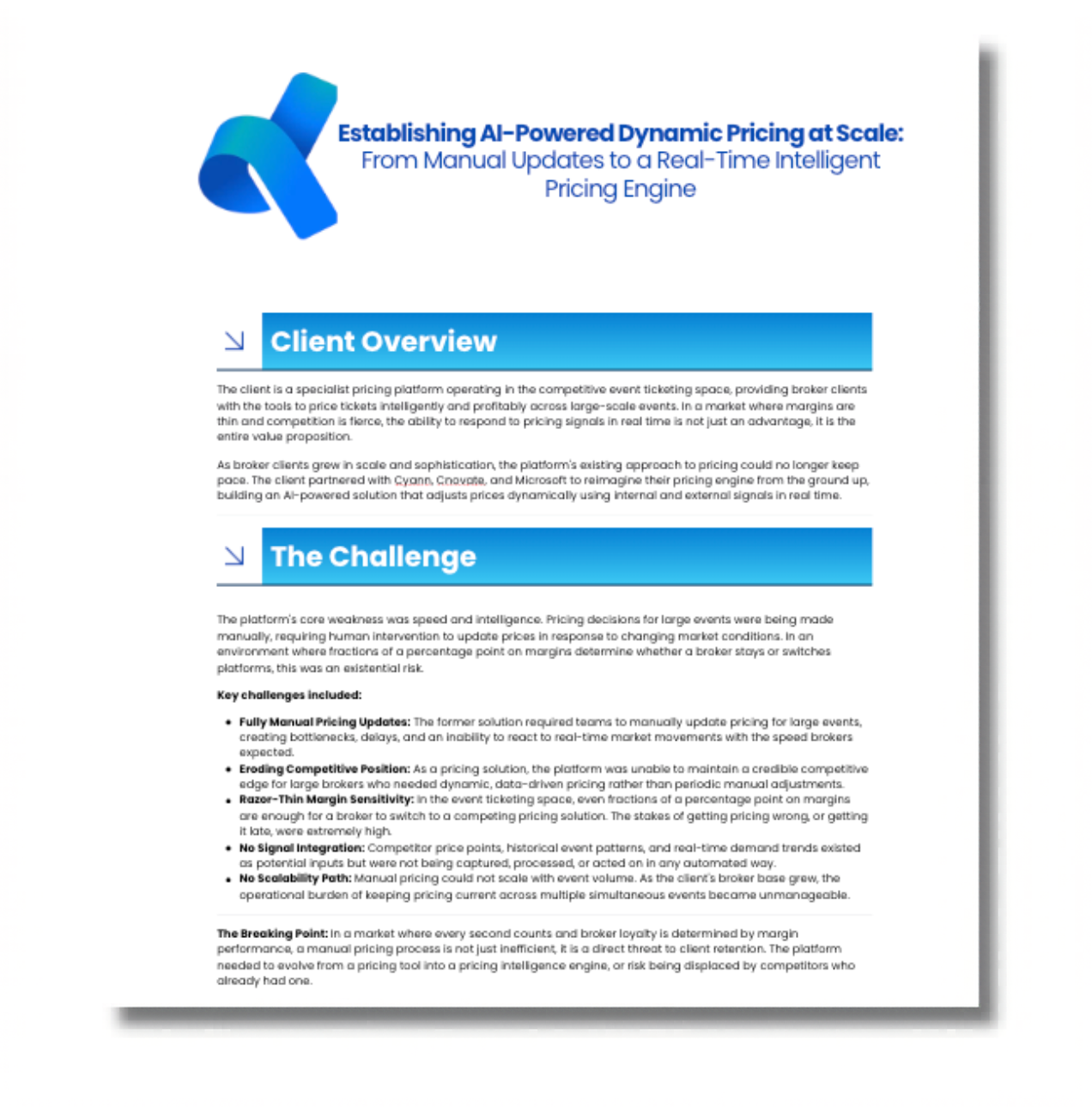
From slow, manual price adjustments to a real-time, signal-driven pricing engine that maximizes ticket sales margins at the speed the market demands.
Customer Overview
The client is a specialist pricing platform operating in the competitive event ticketing space, providing broker clients with the tools to price tickets intelligently and profitably across large-scale events. In a market where margins are thin and competition is fierce, the ability to respond to pricing signals in real time is not just an advantage, it is the entire value proposition.
As broker clients grew in scale and sophistication, the platform's existing approach to pricing could no longer keep pace. The client partnered with Cyann, Cnovate, and Microsoft to reimagine their pricing engine from the ground up, building an AI-powered solution that adjusts prices dynamically using internal and external signals in real time.
The Challenge
The platform's core weakness was speed and intelligence. Pricing decisions for large events were being made manually, requiring human intervention to update prices in response to changing market conditions. In an environment where fractions of a percentage point on margins determine whether a broker stays or switches platforms, this was an existential risk.
Key challenges included:
- Fully Manual Pricing Updates: The former solution required teams to manually update pricing for large events, creating bottlenecks, delays, and an inability to react to real-time market movements with the speed brokers expected.
- Eroding Competitive Position: As a pricing solution, the platform was unable to maintain a credible competitive edge for large brokers who needed dynamic, data-driven pricing rather than periodic manual adjustments.
- Razor-Thin Margin Sensitivity: In the event ticketing space, even fractions of a percentage point on margins are enough for a broker to switch to a competing pricing solution. The stakes of getting pricing wrong, or getting it late, were extremely high.
- No Signal Integration: Competitor price points, historical event patterns, and real-time demand trends existed as potential inputs but were not being captured, processed, or acted on in any automated way.
- No Scalability Path: Manual pricing could not scale with event volume. As the client's broker base grew, the operational burden of keeping pricing current across multiple simultaneous events became unmanageable.
The Breaking Point: In a market where every second counts and broker loyalty is determined by margin performance, a manual pricing process is not just inefficient, it is a direct threat to client retention. The platform needed to evolve from a pricing tool into a pricing intelligence engine, or risk being displaced by competitors who already had one.
The Cyann Approach
Cyann, in partnership with Cnovate and Microsoft, designed and deployed an AI-driven dynamic pricing engine built on Azure, combining historical pattern analysis, real-time demand signals, and competitor data to drive automated, intelligent price adjustments at scale.
Solution Overview
- AI-Driven Price Indicators: Built a predictive pricing model using Azure ML that continuously analyses historical event patterns and demand trends to generate accurate, forward-looking price indicators for each event.
- Real-Time Signal Aggregation: Architected a multi-signal ingestion pipeline using Azure Fabric that captures live competitor price points, demand fluctuations, and market signals simultaneously, feeding them directly into the pricing engine.
- Dynamic Pricing Output: Multiple real-time signals are combined and weighted by the model to produce dynamic pricing recommendations that adjust continuously based on current market conditions rather than periodic manual reviews.
- Azure Functions for Event-Driven Processing: Leveraged Azure Functions to trigger pricing updates automatically in response to specific market events, removing human latency from the pricing decision loop entirely.
- API Endpoints for Ticketing System Integration: Built Azure API Management endpoints to enable future real-time integration directly with ticketing systems, positioning the platform for deeper downstream connectivity as the product roadmap evolves.
- Power BI Analytics Layer: Delivered a Power BI reporting layer giving broker clients and internal teams full visibility into pricing performance, margin trends, and signal effectiveness across events.
- Azure Synapse Analytics: Used Azure Synapse Analytics to process and analyse large volumes of historical and real-time event data, providing the foundation for model training and continuous improvement.
Tech Stack
Microsoft Azure · Azure Fabric · Azure ML · Azure API Management · Azure Functions · Azure Synapse Analytics · Power BI
Engineering Insights
- Speed Is the Product in Event Pricing: In the ticketing space, a pricing recommendation that arrives 30 seconds late is worth considerably less than one that arrives instantly. Building the architecture on Azure Functions and Azure Fabric was a deliberate choice to minimise latency at every stage of the signal-to-price pipeline.
- Multi-Signal Models Outperform Single-Variable Approaches: Pricing based on historical data alone produces static recommendations. Pricing based on competitor signals alone produces reactive ones. The value of this solution came from combining both with live demand data, producing recommendations that are simultaneously informed by context, competitive positioning, and real-time market movement.
- API-First Architecture Unlocks Future Value: Building API endpoints for ticketing system integration at this stage, even before those integrations are live, was a strategic infrastructure decision. It means the platform can expand its real-time capabilities without needing to re-architect the core pricing engine when the time comes.
- Margin Sensitivity Demands Model Precision: When broker decisions are influenced by fractions of a percentage point, model accuracy is not just a technical metric, it is a commercial one. Investing in Azure Synapse Analytics for robust historical data processing was what gave the Azure ML model the training foundation needed to operate at the precision the market requires.
Results
The AI-powered dynamic pricing engine delivered measurable improvements across speed, accuracy, and commercial competitiveness:
- 3x Faster Pricing Updates: Pricing adjustments for newly introduced variables are now processed three times faster than before, giving broker clients a significantly more responsive platform.
- Revenue Optimisation at Scale: Real-time demand signals are now captured and acted on automatically, maximising ticket sales margins across events without manual intervention.
- Operational Efficiency Transformed: Automated pricing decisions have removed the manual overhead that previously limited the platform's ability to handle multiple large events simultaneously.
- Competitive Edge Restored: The platform can now credibly support large brokers with dynamic, intelligent pricing that responds to the market in real time, directly addressing the retention risk the manual approach had created.
- Scalable Growth Foundation: Adaptive pricing strategies can now be deployed across multiple concurrent events, enabling continuous profitability improvements as event volume grows.
Conclusion
In the event ticketing space, pricing is not a background function, it is the core of the business. When the margin between winning and losing a broker relationship is measured in fractions of a percentage point, a manual pricing process is simply not a viable long-term model. By deploying an AI-driven, multi-signal dynamic pricing engine on Azure, Cyann and Cnovate gave this pricing platform the intelligence and speed it needed to compete. The result is a solution that prices smarter, reacts faster, and scales further than anything manual processes could deliver.